
Infrequently asked questions about my new book 'Architectures of Global AI Governance'
The hard questions even my critics don't dare ask

[late-posting a much-overdue update]
The Book
As you might have become aware—through my interminable oh-no-my-publishers-are-making-me-engage-in-Outreach posting on social media these past couple of months, perhaps; or if you made the grave, irreversible error of ever sharing your email with me— … I published my first book this fall!1
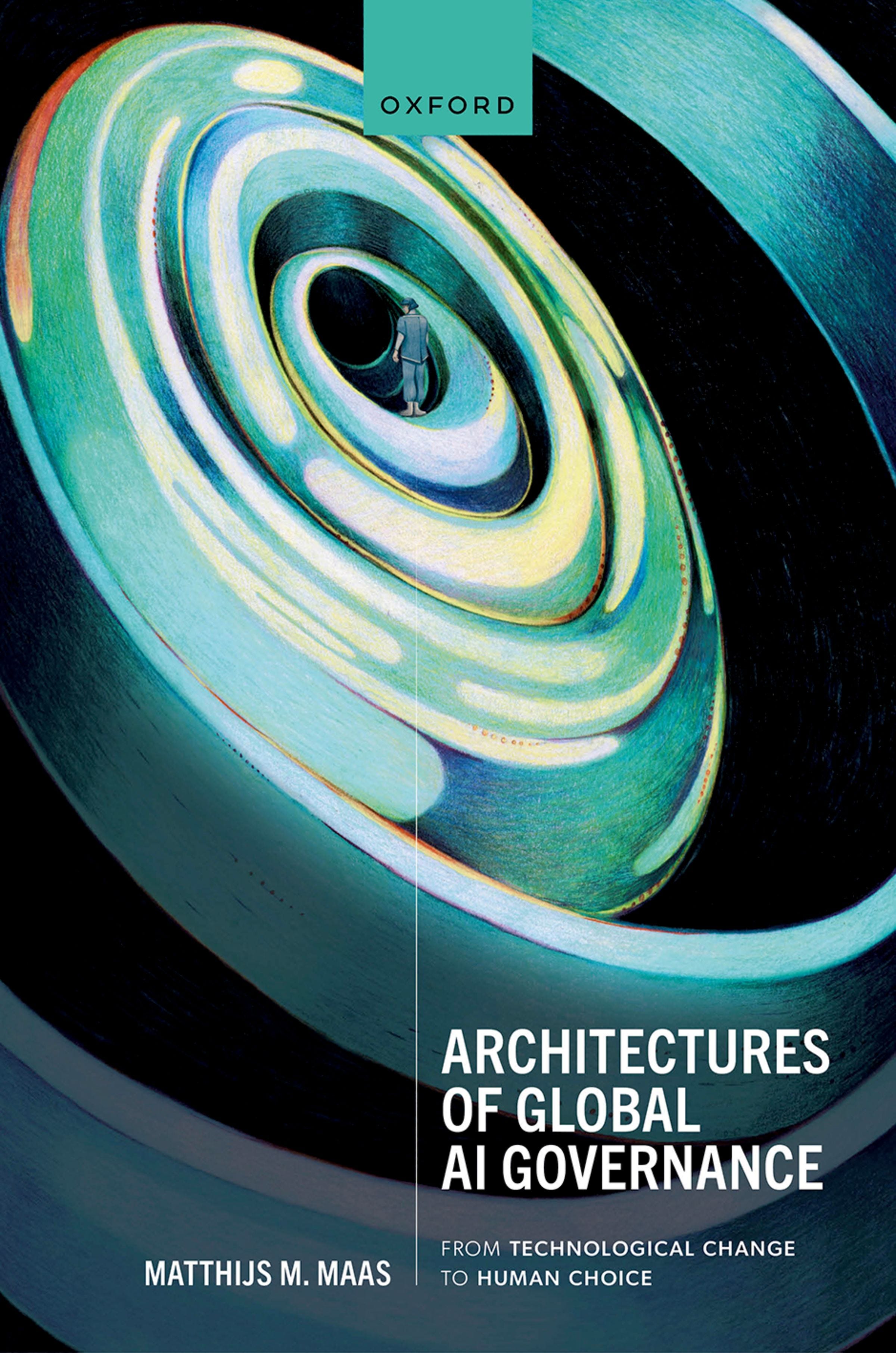
Credit: the wonderful cover art I owe to Sing Yun Lee
Architectures of Global AI Governance (OUP, 2025) comprehensively charts the history, origins, and future of global AI governance in a technical, political, and legal perspective. In it, I draw on technology law, global governance studies, legal theory, and tons of historical examples from across other technology governance regimes, to help understand and overcome key challenges facing the emerging but fragmented global governance architecture for AI.
Should you use compute thresholds in your AI treaty? What are the pitfalls when courts try to speed up legal adaptation to new (AI) technologies by invoking analogies or metaphors? What is the Most Important™ AI Issue? What's the menu of functions that international institutions might play in AI governance, and how is it larger than ‘the IAEA’? Isn't AI a bubble anyway? What are the prospects for an expert-led ‘epistemic community’ at midwifing any arms control agreements for military AI applications? How do you best manage the interactions, redundancies and conflicts between different institutions governing different AI issues at distinct points in its supply chain?
This book, I am especially happy to report, exhaustively resolves these and all other outstanding questions, issues, and problems facing governments, institutions, or scholars, for all domains of international AI governance. It's done. Go home.2
It's even in print! Although you can settle for the Open Access PDF, if for some reason you don't want this gorgeous object adorning and stressing and breaking your bookshelves:
Credit: the wonderful wooden toddler tower in the background I owe to my in-laws
Shortly after publication, my Oxford University Press editors3 referred me to the Oxford Academic marketing website, which helpfully informed me that I am to engage in ‘Self Promotion’, as this will help me ‘Raise [my] Professional Profile’, ‘Elevate [my] Research', and ‘Achieve Impact’. I suppose I would like some of that, yes.
What's that? ‘Do a podcast?’ Great idea, if I had not unfortunately specifically failed to reply to a whole bunch of well-meant requests over the last month.4 So I guess it's back to the drawing board. Specifically, in the time-honored tradition of ‘University comms departments everywhere trying to extract a publishable confession from academics’, let us turn to the vaunted genre of the take-home self-administered interview, as a placeholder to tide you over until I can get something recorded.5
So: let's ask some of the questions I'm not frequently asked about my book.
The interview
The following has been edited for maximally adhering to Substack style, whatever that is.
…
Q. I have heard that this book is a ‘doorstopper’. Is this true?
A. Yes. The print book has been officially rated as a ‘tome’ by other authors of tome-like books, and will adequately stop your doors, with the possible exception of some vault doors.
Note that the digital PDF version will stop no doors. However, the full-version-with-cover clocks in at over 100mb, occasionally crashing the OUP website when you try to download it.6 I think this counts as stopping a virtual door.
Q. What’s the most obsessively nerdy and unnecessarily orthogonal footnote in the whole book?
I'm glad you asked! There are so many contenders:
Maybe footnote 16 in the introduction, which tries to cram a majority of the AI opinion surveys from the last few years into a single footnote, to my copy-editors’ lasting grief
or maybe ftn 192 in chapter 1, discussing arguments around the predictive track record of past futurists and famous sci-fi writers
or perhaps ftn 293 in chapter 1, discussing attempted export control regimes throughout history, including effective embargoes by the Liao and Xixia empires which managed to prevent the Chinese state from procuring good warhorses during the Northern Song period).
or maybe it is footnote 111 in Chapter 3, discussing the prospects that the Soviet thermonuclear bomb program might have gone gone ahead and succeeded even if the US had not pursued it, given that it appears that (contrary to the fission bomb) the H-bomb programme was not a copy of the American one, but appears to have been based on genuine and independent breakthroughts;
or perhaps it's footnote 154 in chapter 5, lovingly charting the ways that U.S. “supercomputer” thresholds were revised six times in under a decade, moving from 195 MTOPS in 1991 to 85,000 MTOPS by 2001…
…or maybe it is …
Q. Seriously—a book on ‘international’ governance? Have you looked at the multilateral system?
A. As I mention in the book, international governance has never been easy or complete; but (1) a regime need look like a centralized, worldwide, and comprehensive formal treaty for it to count as governance, nor for it to be effective; (2) the scope conditions for technology governance have shifted and jumped frequently in the past—including beyond the previous Overton window—and they can all do so again (see also Chapter 7.2.); and (3) many of the insights developed in the book, although applicable to international governance, are also transferable to domestic legal systems—helping inform questions of when, where, and how to regulate AI; how to ensure regulatory flexibility and adaptability; how to think about questions of legal automation; and how to shepherd inter-institutional cooperation on AI technology issues that criss-cross conventional industrial or application-focused boundaries.
Q. What's the most misused word in technology law?
A. ‘Technology’, see Chapter 4.3.
Q. So, should we automate international law?
A. Only those parts of it that are entirely, fully, completely uncontested and uncontroversial; or: those parts of it not subject to the transparency-security tradeoff or easily spoof-able by data poisoning attacks, or… (see Chapter 5.6.)
Q. Is this the kind of book that can be read on a beach?
A. (Stop making me feel bad about living up in the Northern Hemisphere in December)
But, yes, sure, if you have reason to believe that the cute lifeguard whose attention you're trying to attract somehow has strong opinions about the strengths and drawbacks of technology neutrality in regulation; about the proper roles of trend extrapolation, expertise-aggregation, and reasoning-by-analogy in informing technology policy; or about the proper timing for AI regulation under uncertainty…
(which, if they’re worthy of you, they totally should)
… then yes, do read it on the beach.
Q. How much has your own family read of this book?
A. I'm not sure, though a few of them looked decidedly nervous when I handed them a print copy. However, Chapter 4 has been very effective at putting my 3 year old to sleep in evenings, and I think this counts.
Q. Do you think this book will age well, given how quickly and unpredictably AI is developing?
A. Better than yours.
Q. Who should definitely not read this book?
A.
People who find footnotes emotionally or aesthetically threatening;
People who believe that no law, institution, scholarship or historical example from before a precise date in 2022, could possibly be relevant to, or shed light on, the regulation of modern AI
People who find it more comforting to pretend there is no responsibility to choose
Q. Be serious: how much of this book was written by AI?
not a word! That is not even a principled stance or objection, but I am quite particular about my writing—it's the only way I have of really sorting out my thoughts—and too nervous about ending up as a ‘write-not’ in the long run.
Q. What would the world look like if the ideas in this book were taken seriously by policymakers?

Q. I must have this book. Right now. Please tell me where can I get it?
A. Fine. If you insist on missing the numerous links I've repeatedly spammed you with above:
Open access PDF (large with cover), or 4mb link
Q. I would like to help you spread the insights of this book
My friend, you are too kind.
If you think the book will be of interest to your students, colleagues, friends, elected representatives, or pets, it would be great if you could share it with them
since (print) academic books are usually aimed at the institutional market, if you are at or affiliated to a higher education or research institution, it would greatly help me if you told your library about the book (and its online availability), through this OUP form.
If it is of interest, you can also request a review copy of the book, by registering your interest with OUP
With that done, we shall now resume our regularly scheduled programming.
This was about the fourth-biggest event for me in October; the others were the birth of our daughter, receiving a CUP contract for the next book (much to my family's dismay—‘not another one’), and beating my better half in a card game, and no I will not rank these.
Ok, no, don't. The book does, in fact, leave a whole bunch of unanswered questions and gaps. But please do consider that this (along with some of my previous work) now provide an attempted comprehensive one-stop shop to the state of global AI governance, and that it really can be useful to review or check out sections, when taking on the many future research questions in this space.
Who are, it should be clear, wonderful and have been amazing guides throughout the publication process. No, seriously, their level of understanding and patience has been nothing short of angelic, after I received a book contract some years back and then promptly went and took a detour through new-parenthood before taking an extensive time to write and update the book.
If this is you: I apologize for dropping the ball; I was genuinely excited and honored by the invitations; and I hope to still respond and organize some of these in January or so…
This should be fine; I won’t be biased—I’m my own harshest critic.
I've said this to you a few times before, but I wanted to repeat: thank you so much for your tireless effort to write this much needed "tome".
For everyone's sake, I hope it gets the attention it deserves. As part of my work, I'll be helping to spread the word.
Congrats on the book! I'd love to get my hands dirty on it, but maybe focusing on a specific chapter/section first. Which bit(s) of your book would you recommend as most relevant to someone who is most focused specifically on existential risk reduction and (although been in the AI safety space for a while) has only just become recently interested in AI governance after reading MIRI's "AI Governance to Avoid Extinction" and Hendrycks et al's "Superintelligence Strategy"?